Mycelarium Demo Gameplay: How the Mushroom Growth Simulator Plays
If you have been searching for Mycelarium demo gameplay, you likely want to know what it actually feels like to play this fungal growth simulator before.
If you have been searching for Mycelarium demo gameplay, you likely want to know what it actually feels like to play this fungal growth simulator before deciding whether to keep an eye on it. Based on a full demo playthrough, the game drops you into the soil as a tiny mushroom and asks you to expand a living mycelial network across a map that keeps growing the further you reach. This article breaks down the core mechanics, resources, threats, and strategies visible in the demo so you know what to expect.
What Is Mycelarium?
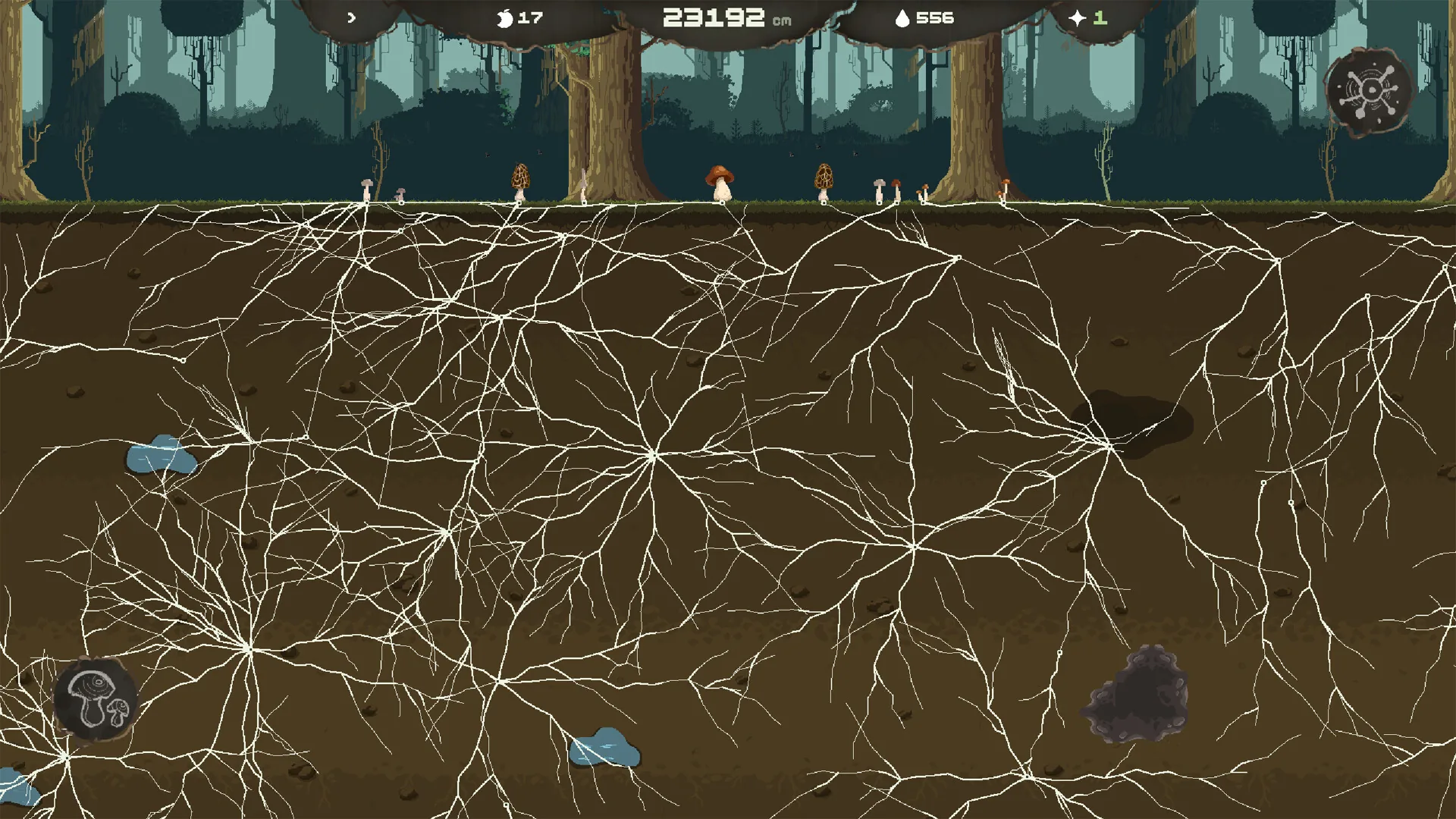
Mycelarium is a chill, expansion-focused simulation game centered on the life cycle of fungi. In the demo, you control a mushroom and its underground hyphae, branching outward to claim resources and build a larger network. The presentation is relaxed, but the loop is compulsive: the moment you secure one resource, three more become visible just beyond your current reach. The demo represents an early version of the game, with the developer indicating that more technology and content are planned for the full release.
The Core Loop: Eat, Drink, Grow
The demo’s gameplay can be summarized in three words the player uses early on: eat, drink, grow. You begin as a single mushroom. From it, you choose a hypha—a thin fungal thread—and click anywhere along that branch to build a node. From that node, you can shoot another hypha in a new direction. Every shot extends your network, and every extension opens access to water, salt, and organic matter scattered across the map.
The controls are simple point-and-click, but positioning matters. Because each action consumes resources, you quickly learn to plan routes that pass through multiple resource pockets in a single line rather than firing blindly in every direction.
Resources: Water, Salt, and Food
Three resources drive the demo economy.
Water
Water is the fuel for movement. Firing a hypha costs water, and each individual water source on the map can only be harvested once. This creates natural checkpoints: you cannot farm the same puddle forever. One important environmental factor is rain—during rainfall, shots do not cost water, giving you a window to expand rapidly without draining your reserves.
Once you have placed a node, you can fire additional hyphae directly from it at the cost of water. This means you do not have to trace your way back to the original mushroom to keep growing; a well-placed node becomes a permanent launchpad.
Salt
Salt functions as a building material. Eating salt generates points that you spend to construct nodes and mushrooms. In the playthrough, the player notes that consuming a salt deposit yields a modest return—sometimes just enough to cover the cost of the shot used to reach it—so salt is best treated as a means to unlock new build options rather than a resource to hoard indefinitely.
Food
Food is the currency for mushrooms. Building a mushroom costs 20 food. You generate food by decomposing fallen leaves and by trapping flies with specialized predator mushrooms. Food is not a static stockpile: it drains over time, which means you must keep expanding and keep producing simply to maintain your current network. Stagnation is not an option.
Mushrooms, Upgrades, and the Budding Mechanic
As your network spreads, you unlock upgrades that change how you play. The player in the demo invests in increased shot range, allowing a single hypha to travel much farther across the map. Another upgrade improves the odds of the budding giants mechanic: at the tip of certain shots, a free node bud has a chance to appear. When it procs, you gain a new branching point without spending the usual resources, which can trigger chain reactions of expansion if you fire repeatedly.
Mushrooms themselves serve different purposes. You can build them near the surface when your network connects to that area. A predator mushroom traps and eats flies, converting them into food. Fallen leaves can be decomposed for additional food income. The demo hints at a broader tech tree in the full game, suggesting that the mushroom types and upgrade paths will deepen beyond what the demo shows.
Threats and Challenges
Mycelarium does not frame itself as a hardcore survival game, but the demo includes organic pressures that force you to adapt.
Hedgehogs
The most memorable threat in the demo is the hedgehog. These creatures wander the surface and will steal your mushrooms. The player discovers that a hedgehog can only carry one mushroom at a time, which limits the damage of any single theft but does not eliminate the frustration of losing a structure you invested food into. There is no confirmed anti-hedgehog weapon or poison mushroom in the demo; the player jokes about wanting one, but it does not appear to be an available option in this version.
Resource Drain and Map Pressure
Because food drains over time and water sources are one-time claims, the map slowly becomes more demanding the longer you play. You cannot simply turtle in a rich corner; you must keep reaching outward to new water and new organic matter to sustain your empire.
Objectives and Open-Ended Play
One of the most notable things about the demo is how open-ended it is. There is no clearly stated win condition. The player repeatedly asks what the goal is, eventually settling on self-directed targets such as growing the network to 50,000 cm. The map itself appears to keep expanding, with no hard upper limit encountered during the session.
This makes Mycelarium feel closer to an ambient growth toy or a meditative sim than a mission-based game. If you enjoy setting your own milestones and watching systems compound, the demo delivers. If you need explicit objectives to stay engaged, the demo may feel loose—though the presence of a larger tech tree in the full game suggests more structure may arrive later.
Practical Tips from the Demo
If you are jumping into the Mycelarium demo, these strategies drawn from actual play can help you start strong:
- Secure water early. Because each source is one-time only, plan routes that chain multiple water deposits before committing to long shots.
- Exploit rain. When it rains, fire freely. The temporary removal of water costs is the best time to claim distant territory.
- Use nodes as forward bases. Once a node is placed, fire from it directly. This saves you from wasting shots backtracking.
- Invest in range. Upgrading shot distance lets you claim more map per action, which compounds quickly.
- Build predator mushrooms for food. Flies and leaves are renewable food sources; a predator mushroom can flip you from scarcity to surplus.
- Accept hedgehog losses. They will steal mushrooms. Build redundantly rather than relying on any single structure.
- Keep expanding. Food drains, so a static network will slowly starve. Growth is maintenance.
Demo Scope and What Comes Next
The demo is a vertical slice of the core loop: shoot hyphae, claim resources, build mushrooms, and expand. It is polished in its small ways—the fungal growth visually branches and sprouts along paths, giving the network an organic, wood-like texture—but it is explicitly unfinished. The developer notes that more technology is planned, and the mention of a fuller tech tree implies that the release version will layer additional progression on top of the sandbox expansion seen here.
For players who want a low-pressure sim about becoming a mushroom and consuming the underground, the demo is a pleasant surprise. It is simple to learn, but the compounding nature of node placement and resource routing gives it enough depth to keep you thinking about your next shot.
Where to See It in Action
If you prefer to watch before you play, a full demo playthrough is available on YouTube at https://www.youtube.com/watch?v=4QZeCl9SDyk, showing the loop from the first hypha to a sprawling network covering most of the visible map. Watching an experienced player route through water and salt pockets is one of the fastest ways to internalize the game’s spacing and upgrade priorities.